
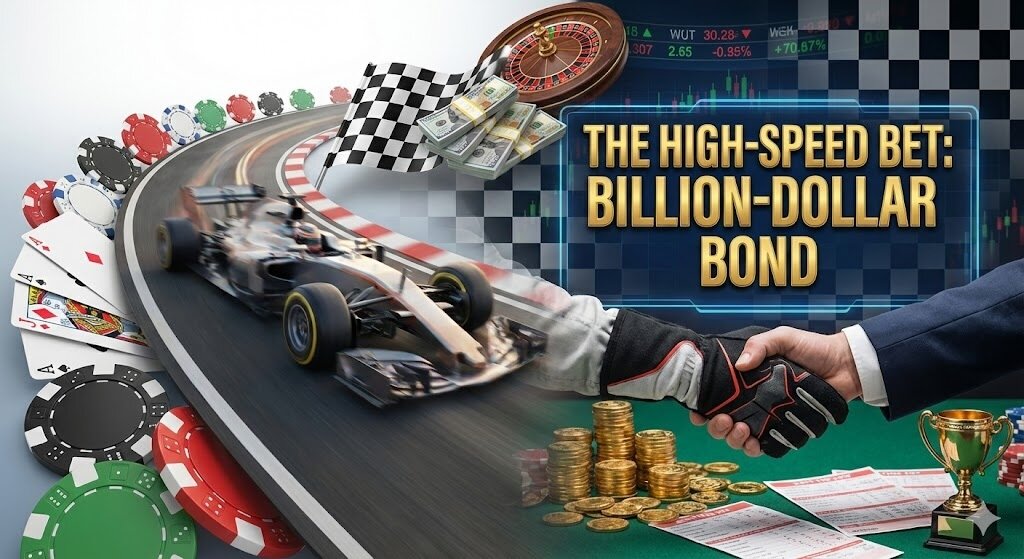
The roar of a Formula 1 engine is more than just a feat of engineering; it is the sound of capital seeking a platform. The world of motorsport has changed over the last century, no longer a contest of national pride but a high-speed billboard, advertising those industries that have prospered on risk, adrenaline, and large disposable incomes. Regardless of the fact that direct investment in the automotive industry has increased and decreased with the prevailing economic conditions around the world, the funding gap has always been bridged by the vice industries. The initial example was that of Big Tobacco, which developed the template of global lifestyle branding, this day it is Big Betting.
This has changed the grid into a war on market share, with online gambling sponsors now taking the prime real estate that cigarette manufacturers used to control the market with. This discussion examines the intersection of these two high-speed industries and the evolution of the culture of the so-called gentleman driver to the present-day digital gold rush.
From National Pride to Corporate Billboards
In order to feel the magnitude of modern gambling in motorsport, it is important to refer to the sterile business environment that the sport was born out of. In the first six decades of the 20th century, the visual language of Grand Prix racing was determined by the Association Internationale des Automobile Clubs Reconnus (AIACR). Painting of cars was done based on strict national color codes, i.e, Rosso Corsa in Italy, Bleu de France in France, and British racing green in the UK. The automobile was a national symbol and not a commercial billboard.
The Watershed Moment of 1968
The moment in economic history came in 1968. Teams applied to the FIA to lift the ban on commercial sponsorship when they faced the withdrawal of some of their key industrial partners, such as BP and Shell. The outcome made the amateur ethos dead and gave life to the commercial monster.
Although the first sponsorship livery has been attributed to Team Lotus, it was a South African privateer team that initiated the first sponsorship livery. In the 1968 South African Grand Prix, John Love, in his Brabham, did not show up in South African colours, but in the orange, brown, and gold of Gunston Cigarettes. Several months later, Colin Chapman of Lotus entered into an industry first with Imperial Tobacco, having his cars resprayed in the red, gold, and white of the Gold Leaf brand. This model of livery takeover became the pattern under which online gambling sponsors operate today: through the car, it is possible to circumvent the domestic advertising bans by broadcasting on international television.
The Early Flirtations: Casinos and the Playboy Lifestyle
Until the internet era, the association between gambling and racing was physical, the lifestyle of the Playboy and the destination casinos.
The Hesketh "Playboy" Era
Vice sponsorships were pre-empted in the 1970s by a hedonistic image created by Hesketh Racing, run by the chapeauvinous Lord Hesketh and driven by James Hunt. Hunt, in his patch about Sex, Breakfast of Champions, was the representative of the risk-loving behaviour, which has a psychographic similarity with the target population of high-stakes gambling. The crew eventually took on the support of Penthouse Magazine, taking the adult entertainment industry into the grid, a forerunner of the contemporary deals that cross-pollinate with influencers and streamers.
The Caesars Palace Experiment
The initial explicit cash convergence took place in the early 1980s with the Caesars Palace Grand Prix. To rebrand Las Vegas as a sporting capital around the world, the casino held an F1 race in its parking space. The event was of economic importance, though drivers despised the track because it was a repetitive concrete maze. It was the first time that a gambling company used the prestige of F1 to bring whales on its gambling floor, and this would remain dormant until the reintroduction of the Las Vegas Grand Prix in 2023.
The Digital Revolution: Poker and the Internet Boom
The end of the millennium saw the close of the Tobacco Era, with high-speed internet and online poker boom making huge fortunes available to a new category of sponsors.
The Poker Boom
Online Poker has gone on a worldwide spurt since the 2003 win of Chris Moneymaker at the World Series of Poker, who had entered the tournament online. Firms such as Full Tilt Poker took advantage of this opportunity by joining F1. In 2010, Virgin Racing scored a big deal with Full Tilt. But the joint venture failed after the so-called Black Friday in 201,1 when poker domains were confiscated by the US Department of Justice, exposing the money mismanagement at Full Tilt. This scandal made F1 treat online gambling sponsors with care in the course of ten years.
MotoGP and the bwin Dynasty
F1 took a back seat as MotoGP embraced the sector. The betting giant bwin established itself as a mainstream player, sponsoring high-profile races and making betting odds on trackside hoardings to become a regular occurrence, paving the way to the current overload of betting brands in two-wheeled racing.
The Liberty Media Era: Opening the Floodgates
When Formula 1 was sold to Liberty Media in 2017, the conservative era of Bernie Ecclestone was over, and the new management increased its commercial growth aggressively. In 2018, Liberty reversed the 40-year ban on gambling partnerships 2018 by identifying the US sports betting market as an enormous growth potential after the repeal of the PASPA.
Data-Driven Partnerships
This control turnpoint permitted advanced integration. In 2020, F1 also declared its Asian Betting Partner as 188Bet. This was a deal with significant data integration, unlike the inert, inactive logos of the past, so the bookmaker was able to offer micro-betting markets in-play (e.g., whether a driver will pit in the next three laps). This transition changed the proposition of value to be less based on brand awareness and more based on user engagement.
Large teams were soon to adopt the same. Entain (PartyPoker) collaborated with McLaren, and the agreement was based on the idea of Responsible Gambling and the psychology of risk management in common. Red Bull Racing was even more audacious with Pokerstars by positioning a branding on the halo of the car so that it can be seen the most in on-board camera shots.
The Crypto-Casino Convergence: The "Stake" Era
The boundary between cryptocurrency and gambling has become unclear in the 2020s, and the most profitable and controversial transactions in the history of the sport have been made.
The $140 Million Stake Deal
The recent peak of this trend is the title partnership between Sauber F1 Team and Stake.com. This transaction is worth an estimated value of about $100 million USD, as the team is officially to be known as Stake F1 Team Kick Sauber. It is a total identity takeover by a crypto-casino.
Alibi Marketing 2.0
In order to move through the tangles of international gambling regulations, franchises have devised "Alibi Marketing." Stake.com co-founders are also the owners of Kick video streaming platform. The car operates as a Stake in the countries where gambling advertising is legal. In countries where the ban is tight, like in the Netherlands or Qatar, the branding changes to Kick. Although it is technically an advert for a streaming service, the similarity of colour palette and the ownership secures that it will not undermine the brand association, a technique which is explicitly reminiscent of these Campaigns by Big Tobacco, called Mission Winnow.
Ferrari has not been left behind and has become a partner of Virtual Gaming Worlds (VGW). Promoting social casinos that act under sweepstakes laws, Ferrari does not need to directly encourage gambling, and still gains access to the huge liquidity in the sector.
The North American Pivot: NASCAR and IndyCar
It is a revolution that has taken place in the United States. NASCAR has maintained decades of a seemingly family-friendly reputation by prohibiting vice sponsorships. The economic calculus, however, shifted with the 2018 Supreme Court ruling.
In 2019, NASCAR took a new turn, and the teams had a chance to sign contracts with sportsbooks. The financial situation was in stark reality: the organization was still profitable, but teams were not making much on a razor-thin margin. One of the survival strategies was sponsorship. This resulted in high-profile relationships, including DraftKings sponsoring 23XI Racing, which is a team that Michael Jordan co-owns.
The IndyCar has also been able to cross over into the physical and the digital world. Deals with slot machine makers such as Aristocrat Gaming are present at the Las Vegas Grand Prix, which demonstrates a complete localization of the gambling environment into the racing one.
Conclusion: The Cycle of Vice
The history of motor racing sponsorship is a cyclic story of survival. Tobacco replaced the void that oil money had left. In the case of tobacco prohibition, there was the entry of banks and telecoms. Having fallen victim to the outrageous prices of the hybrid and sustainable era, the sport has resorted to online gambling sponsors and crypto platforms.
Nevertheless, regulatory barriers are going up. Governments in the Netherlands, the UK, and Australia are restricting the ability of advertising gambling, compelling teams to depend more and more on the "alibi" liveries. The emergence of such brands as Kick and VGW Play is a defensive measure, an indication that the industry is aware that the time frame of regulation may be getting shorter.
However, what happened in 1968 still holds: the race will always have a scandalous business ready to cover the cost as long as it is costly. The sovereign wealth funds or consumer tech revival is yet to occur, but the high-octane bet on speed versus sponsorship is still undergoing mutation.